PGT Testing in Thalassemia: Is Thalassemia Preventable in the Next Child?
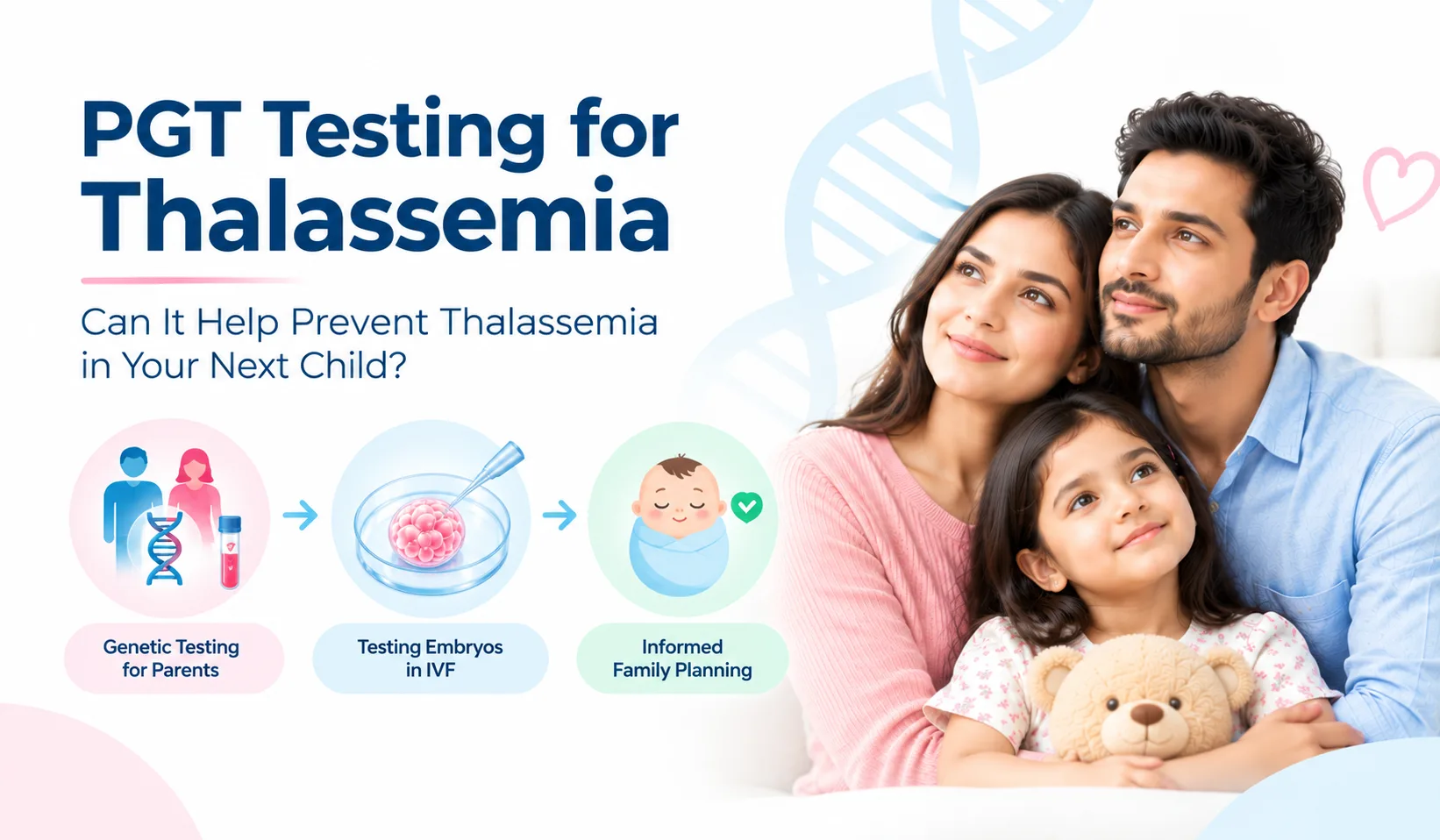
A couple sits across from me and says,
“Doctor, our first child has thalassemia major. We want to have another baby, but we are scared. Could it happen again?”
If you have these concerns, you are not alone. I assure them that thalassemia is a genetically inherited condition, and their risk of having another child with it may depend on the Hbb gene sequence of both of them.
Before trying again, we can check these genes and discuss the chances of the next baby being affected. With recent developments in IVF and ART procedures, its possible to prevent thalassemia in sebsequent baby.
But which test is relevant for thalassemia?
Can PGT-M help, or is another test needed?
Let’s understand what the testing involves, what you can expect from the results, and the options available to you.
What Is Thalassemia?
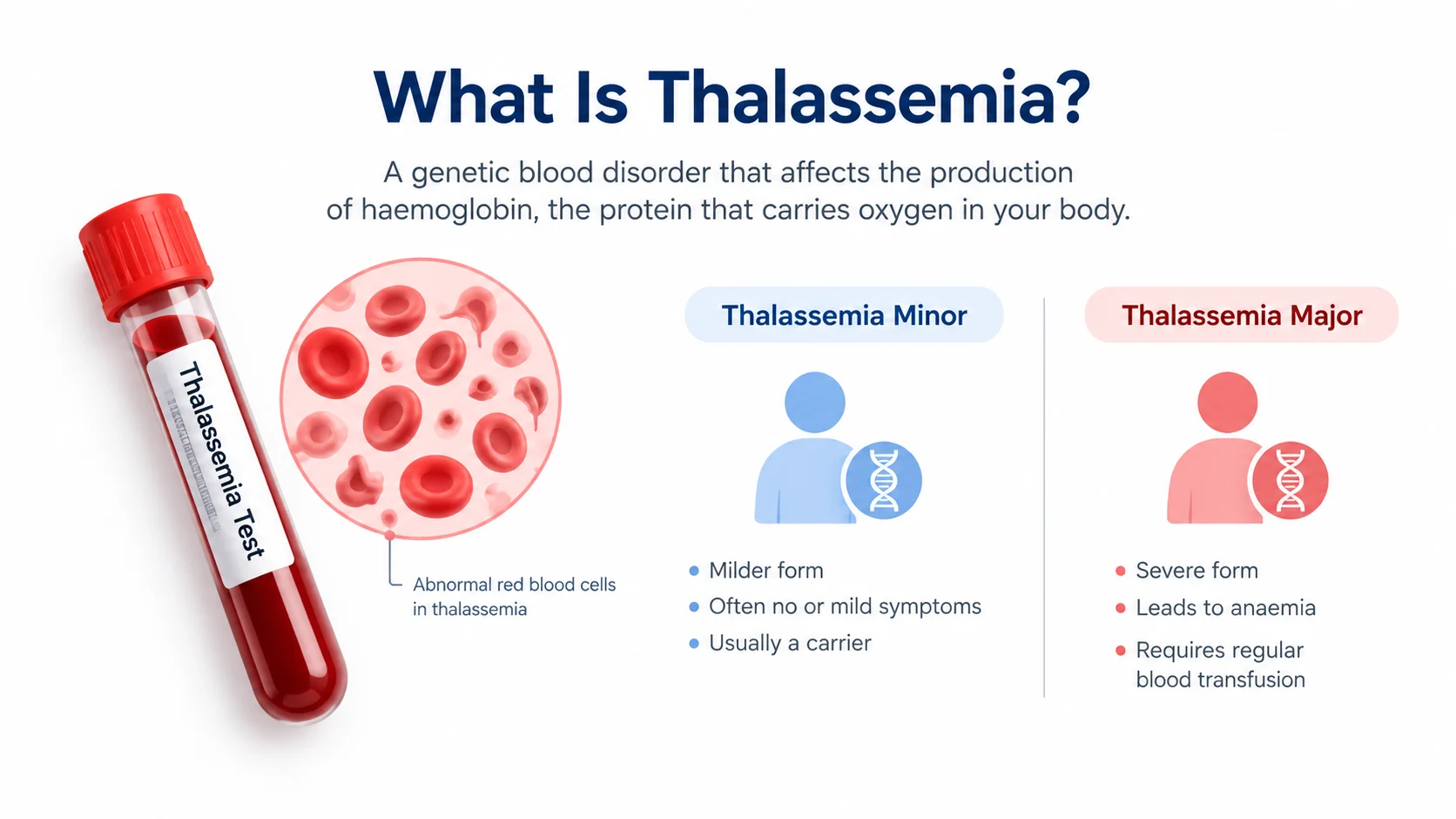
Thalassemia is a blood disrder that arises due to genetic causes and impacts the production of haemoglobin. Haemoglobin is a vital substance that helps carry oxygen to other parts of your body.
So, what exactly are thalassemia major and thalassemia minor?
Thalassemia Minor: A milder form of thalassemia. The person becomes a carrier of this disorder and has mild or no symptoms at all.
Thalassemia Major: A severe form of thalassemia. This disorder leads to anaemia that requires regular blood transfusion and repeated hospital admission.
A study conducted in 2023 in the Journal of Community Genetics on 69 studies from India concluded that;
Approximately 3,721 beta-thalassemia carriers among 197,735 individuals were tested.
Approximately 8,740 infants with beta-thalassemia major are likely to be born in India annually without taking any precautionary steps.
In Madhya Pradesh, a recent study identified 96 beta-thalassemia carriers among 4,412 pregnant women who were screened.
These numbers show why thalassemia remains an important concern in India and Madhya Pradesh. But for parents who already have a child with thalassemia major in Indore, the concern is more personal.
Let’s look at the challenges they may face when planning another pregnancy.
What Challenges Do Parents Face After Having a Child With Thalassemia?
Having a child with thalassemia can affect the whole family.
Treatment can also be extremely costly, with supportive care for thalassemia major in madhya pradesh estimated to reach around ₹2.5 lakh a year, depending on the child’s needs. Every month we have one couple asking us, is it possible to prevent thalassemia in my child at your hospital in indore?
Also is it possible that second child has perfect HLA match of first child for being the repeated blood donor?
Can Thalassemia Be Prevented in the Next Child?
Yes, the risk of having a child affected by thalassemia can be reduced with the right genetic testing and planning, although it cannot be completely guaranteed.
According to the NHS:
If both parents carry a beta-thalassemia gene change,
Each pregnancy has a 25% chance of thalassemia major
A 50% chance of being a carrier (thalassemia minor)
A 25% chance of not inheriting the gene change
Dr. Vedant Jain explains,
“Having one affected child does not mean that your next child will definitely have thalassemia, but understanding your genetic risk before pregnancy is important. There are several prevention options, such as amniocentesis and antenatal thalassemia testing. There are even superior options available, like testing for thalassemia at embryo level and transferring a thalassemia-free baby ”
Nowadays, IVF gives us an opportunity to test embryos before transfer, which can help us better understand certain genetic risks when planning another pregnancy.
What Is PGT-A Testing in IVF?
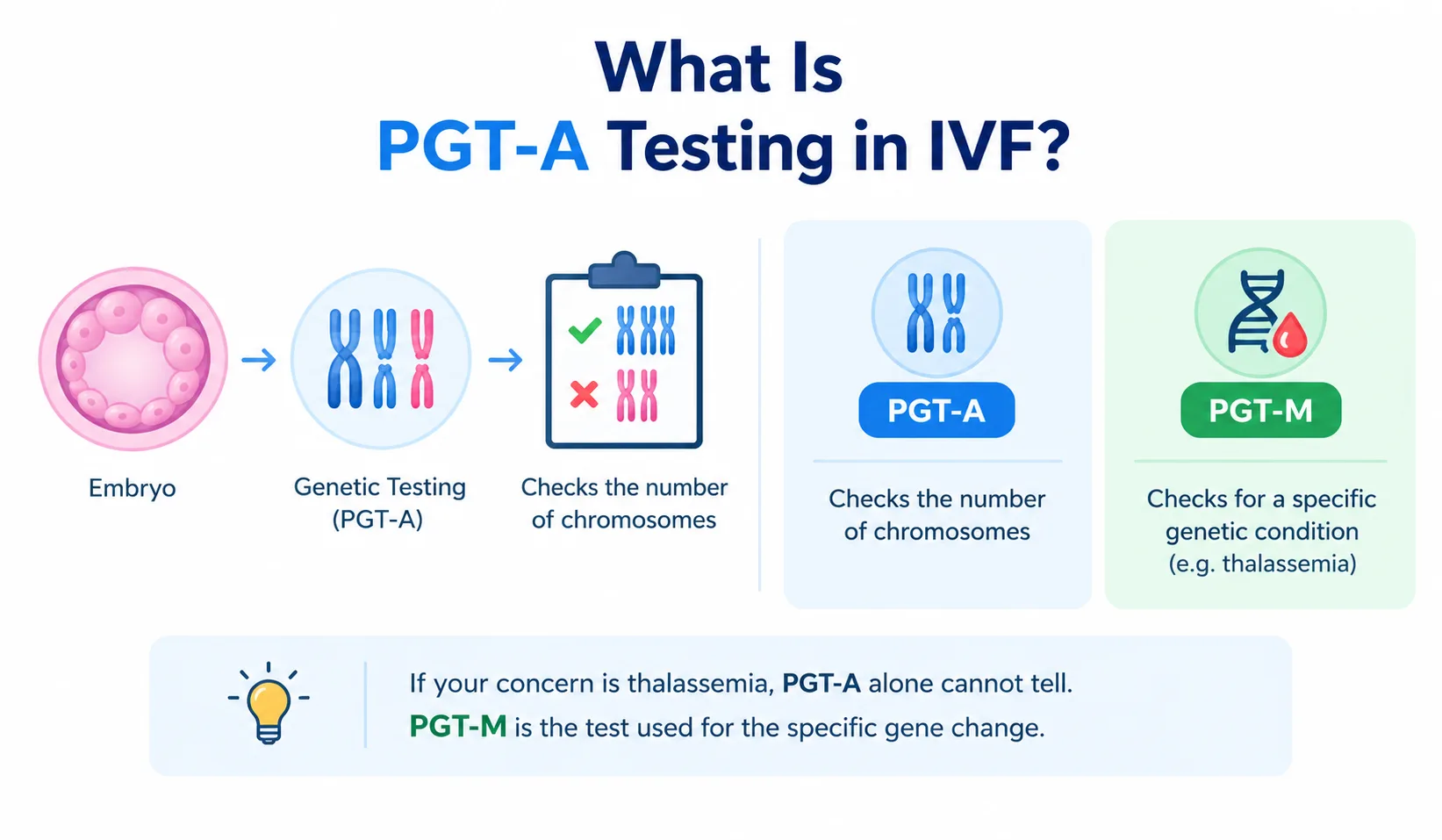
PGT-A stands for Preimplantation Genetic Testing for Aneuploidy. It is a type of genetic screening performed on the embryo during the process of IVF to detect whether the number of chromosomes in the embryo is correct.
PGT-A vs PGT-M for Thalassemia
The two tests look for different things:
Test | What does it check? |
PGT-A | Checks the number of chromosomes in an embryo. |
PGT-M | Checks for a specific genetic condition, such as thalassemia, when the family's gene change is known. |
HLA Matching | Its possible to match HLA of embryo with the index child so that in future this baby can donate his or her bone marrow to index child. |
So, if your concern is thalassemia, PGT-A alone cannot tell whether an embryo has thalassemia. PGT-M is the test used to look for the specific thalassemia-related gene change.
In IVF cycles, we consider using both tests, depending on the couple's genetic and reproductive situation.
PGT-A and PGT-M Testing Procedure: Step-by-Step
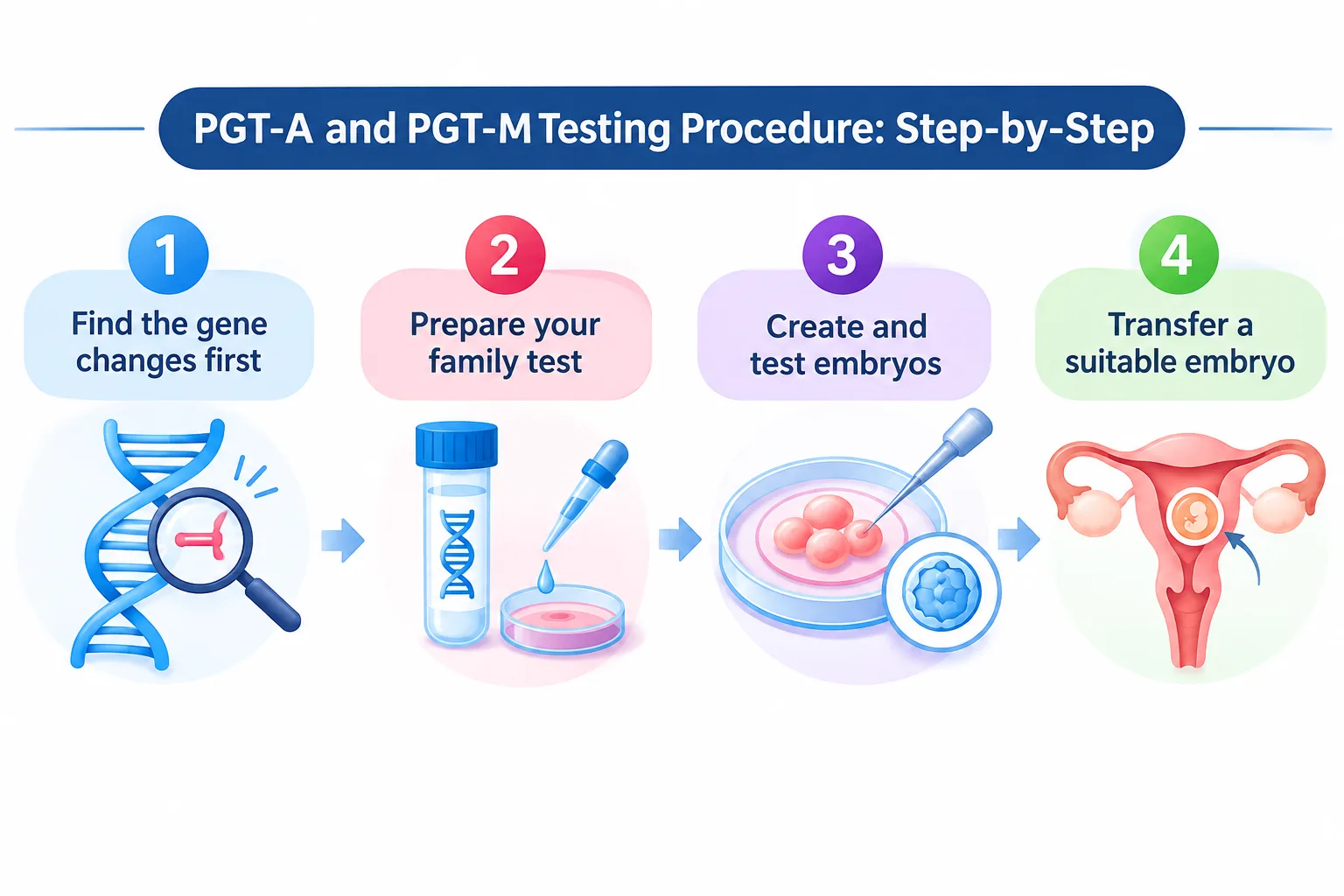
For parents planning a second child after having a child with thalassemia, the process generally involves:
1. Find the gene changes first
We first identify the exact thalassemia-related gene (Hbb sequencing) changes in both parents. We may also need a sample from your affected child to understand the family’s specific changes.
2. Prepare your family test
The genetic lab then creates a customised genetic probe for these genetic changes before your IVF cycle begins.
3. Create and test embryos
The couple undergoes IVF/ICSI and produces several eggs. After fertilisation, the embryos grow to the blastocyst stage (Day 5 embryo).
We then collect a few cells from the blastocyst (blstomere biopsy) and send them to the laboratory, where they are tested using the customised family-specific test probe.
4. Transfer a suitable embryo
Your each embryo is labelled and frozen while we wait for the PGT results.
The report can show whether an embryo has inherited the familial thalassemia-related gene changes. Depending on the parents’ genetic variants, embryos may be classified as affected, carrier, or not affected by the familial condition.
Based on the genetic results, we may select an embryo suitable for frozen embryo transfer.
PGT-A Benefits and Risks in Thalassemia
Potential Benefits
Helps identify embryos without the familial thalassemia condition.
Allows genetic testing before pregnancy begins.
May reduce the uncertainty of having another affected child.
Risks and Limitations
PGT involves IVF and egg collection.
Not every IVF cycle produces embryos suitable for transfer.
Some embryos may have mosaic results.
Testing does not guarantee implantation or live birth.
PGT-M requires specific laboratory preparation.
Genetic testing has technical limitations.
Prenatal testing may still be recommended.
How Much Does PGT-A Testing Cost in India?
The cost of PGT depends on the type of test, number of embryos, laboratory charges, and whether customized testing is required.
The table below shows PGT testing costs in India and Indore:
Test Type | Approx Cost in India | Approx Cost in Indore |
PGT-A | ₹15,000/ embryo | ₹1,20,000 |
PGT-M | ₹35,000/ embryo | ₹2,80,000 |
These charges may be separate from IVF, embryo biopsy, freezing and frozen embryo transfer. Costs vary between fertility centres and laboratories, so ask your doctor before starting treatment.
Is PGT-A or PGT-M Right for You?
Choosing embryo testing is not the same for every couple. If you have previously had a child with thalassemia, your first step is to identify the exact genetic changes in your family.
PGT-M can then be used to look for those changes in IVF embryos. PGT-A answers a different question by checking chromosome numbers. Your genetic counsellor and fertility specialist can help you understand which approach fits your situation.
Final Thoughts
After seeing your child go through thalassemia, planning another pregnancy can bring both hope and fear. You do not have to make this decision without understanding your options. A detailed genetic evaluation can help you and your doctor plan the next step with greater confidence.
At Asian Institute of Infertility Management, Indore, Dr. Vedant Jain takes the time to understand each couple’s concerns and offers personalized guidance while they consider their path towards another pregnancy. Our goal is not to promise a perfect outcome, but to help you make an informed choice for your family.
Faqs:
Can I have a healthy second child if my first child has thalassemia?
Yes. Genetic testing and IVF with PGT-M can help identify embryos that are not affected by the familial thalassemia variants.
Which test is best for thalassemia in IVF, PGT-A or PGT-M?
PGT-M checks for specific genetic variants responsible for thalassemia, while PGT-A checks the number of chromosomes in an embryo.
Can thalassemia be detected during pregnancy?
Yes. Prenatal testing such as CVS or amniocentesis can check the fetus, and it is usually recommended even after PGT-M.
Can thalassemia be prevented in the next baby?
The risk can be reduced with genetic testing and planning, but it cannot be completely eliminated.
Do we need IVF to test for thalassemia in embryos?
Yes. Embryo testing requires IVF because the cells are taken from embryos created in the lab.
How much does PGT testing cost during IVF?
The cost of PGT testing depends on the type of test, the number of embryos tested, and laboratory charges. IVF, embryo biopsy, freezing, and embryo transfer may involve additional costs.